After eating Lampredotto at the market, the second favorite thing that I did in Florence was to visit the Museo Galileo [www.museogalileo.it]. Florence is most well known for its museums that house classic sculptures and works of art. Almost everyone who visits the city will check out the Uffizi Gallery and pay a visit to Leonardo’s David at the Academia Gallery. To do this people will either stand in an hours long line-up or the smarter ones will make an entry reservation ahead of time – and still stand in line for well over 30 minutes.
After appeasing Mrs A|T for the better part of a day gawking at art and learning the difference between classical styles (which was actually kind of interesting) we set off to find my addition to the itinerary, right around the corner from the Uffizi. Prior to 2010 the museum was known as the Institute and Museum of the History of Science, but just days before we arrived it was relaunched as the Museo Galileo – a museum dedicated to one of my favorite old dudes.

Compared to the other more popular museums that we visited the Museo Galileo was a joy. Possibly due to the fact that it had only just been re-opened, instead of the crowds there were only a few small groups of people visiting the small 2 floor museum. As part of the renovation it seems that the building air conditioning was also upgraded because it was perfectly just slightly cool in the building.
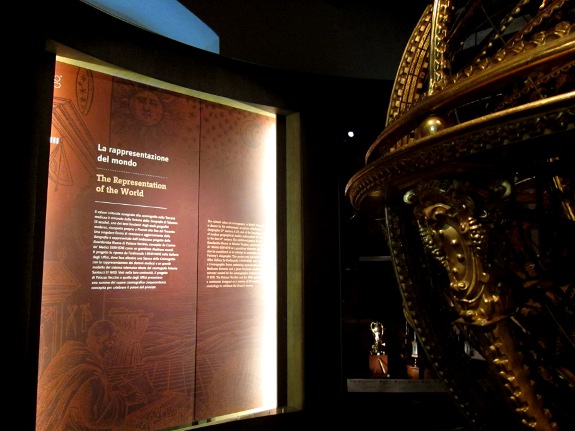
As you make your way through the museum you experience the history of scientific discovery from Galileo’s era. It covers developments in warfare, medicine, and leaps in our understanding of astronomy.
Of course, my favorite part was the Galileo collection which included the actual telescope lens that was used to first observe the moons of Jupiter. Seeing those moons circle another planet cemented the belief that not all objects orbit the Earth, and therefore the Earth was not necessarily at the centre of the Universe.

The lens, which is in the black and white oval frame in the middle of the picture above, is marked as Galileo’s Objective Lens, but not much more information was given in english so I wasn’t sure if that was the one I was looking for. When I asked one of the museum staff about it I was treated to a 20 minute conversation about the lens and about Galileo’s life in both Pisa and Florence. Also on display in the same room are a few of Galileo’s actual teeth and mummified fingers. These artifacts were taken from his grave when they transported him to a new burial site in 1737. I had initially taken a few pictures of those but then almost immediately deleted them out of respect.

It should be noted that I found out at the end of my visit that taking photographs was not allowed inside the museum; however, because they had just re-opened there were no signs up indicating that fact. Fortunately I know how to take pictures without a flash [averagetraveller.com] so I don’t think that I did any harm. They politely told me “no pictures” but did not ask me to erase what I already had.
If historical artifacts mean more to you than classical art, then the Galileo Museum in Florence is an absolute can’t miss. The museum can be seen in under 2 hours, but I would allow half a day if you’re an astronomy and history nerd like me.
This post was submitted to Travel Photo Thursday, a weekly collection of travel photos hosted by Budget Traveler’s Sandbox [budgettravelerssandbox.com]. Be sure to check it out!
That looks like a cool museum. Someday, I’ll have to visit.
You’ve given us a lovely peek. Thank goodness they didn’t ask you to delete your photos.
I would love to visit this museum! This would be a great way to learn more about all this man has done for us.
I like to mix up what I see in a city and I prefer art from the Impressionist period on so I’m not as over the top at seeing the old masters works – and I hate lineups. The museum looks like a find – and the question is did Mrs AT like it?
Mrs A|T liked it but didn’t love it like I did. She did the fast tour and found a nice place to sit for about 45 minutes until I finally caught up with her. She said it was a needed rest after a long day of museuming.
I missed out on the Museo Galileo when I was in Firenze last year. It looks very interesting!
Lovely- my favorite museums are usually the lesser known, less crowded ones. I like to be able to experience the art by myself. Great tour inside!
Museo Galileo looks like a very interesting museum. How nice to visit without crowds! Indeed, Galileo was a great “old dude”. 🙂
A great post on this museum. I’ve checked out the the website and its videos of the different galleries give some really good insights to the place.
Galileo’s teeth and some fingers… A bit creepy for me!
You were luck to get these shots, then. I can never, ever understand the no photos even without flash rules. All they accomplish is to diminish the amount of publicity that they could get from bloggers like us. Pablo Neruda’s three houses here in Chile, which are now museums, have the same rules. On the other hand, not only could I photograph inside the Museum of Modern Art in San Francisco (except for a special exhibition), but they reblogged my photos, themselves!
I agree about photo rules. Almost every museusm that I went to in Italy had a no photos rule and many even had metal detectors to make sure that you comply! I’m putting together a listing of famous museums and their photo policies. It’ll start with around 10 museums but I’m hoping to keep updating it.
I’ve been to Florence twice and still haven’t made it inside that museum, I may have to go back a third time…
There are so many incredible museums in Florence. I would love to hang out and explore this quieter museum.
Gosh, I had no idea this museum was even there. I shall have to check it out when I next go to Florence, as it looks fascinating. Geeks of the world, unite!